The Leapfrog Effect: How Construction Is Skipping Digital Marketing and Going Straight to AI
- May 25
- 4 min read
Updated: Jun 6
The Fate of Construction Innovation
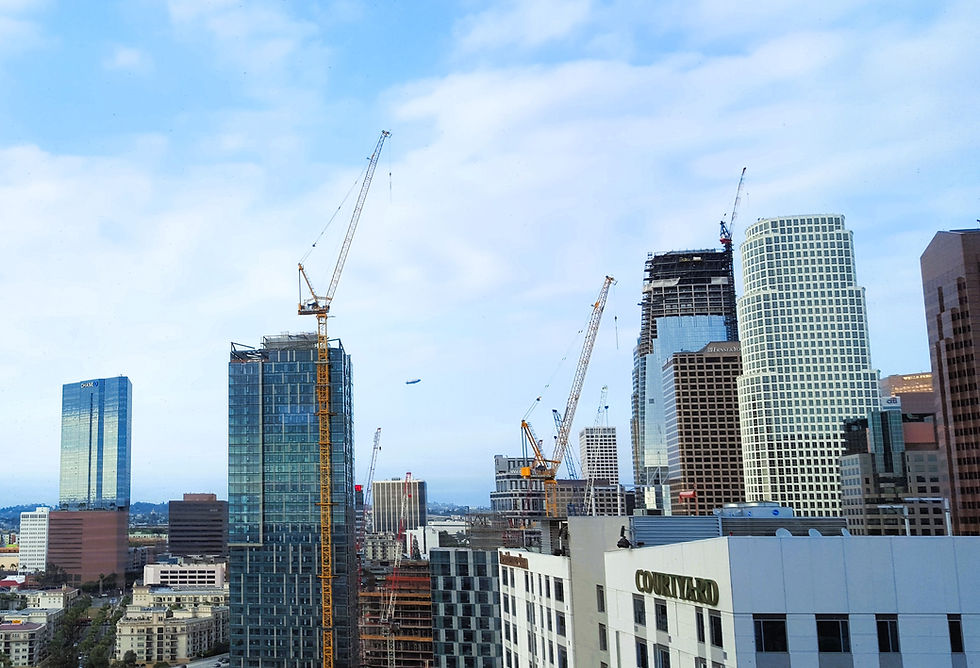
As I look at the Los Angeles city skyline – peppered with the familiar silhouette of tower cranes and graffitied high rises – I am struck by the culture of contradiction now present in the industry. On one hand, construction is immutable in its traditions: building methodologies are the same ones used centuries ago, driven by the painstaking planning, processing, and coordination efforts of people. On the other hand, technology plays a fate-like role on construction operational innovation: the wheel gives way to wagons, the tower crane to skyscrapers, and most recently, artificial intelligence allows data to be an asset.
Artificial intelligence (AI) in particular has hit the AEC (architecture, engineering, construction) industry hard in a few ways; its consequences exacerbated by the ever-narrowing profit margins that most contractors increasingly wrestle with. According to the RICS Digitalisation in Construction Report 2024, digital adoption has stalled in the construction industry – with 43% of firms reporting they use digital tools on none of their projects, a figure that has actually increased year over year. This is a statistic that sounds alarming until you reframe it as opportunity. Because of this, and other issues plaguing the industry, construction companies turn to innovative solutions – and in this case, AI tools – to overcome labor shortage gaps, stay competitive in the market, and win more work.
In many instances, however, marketers in particular fall prey to the ease of AI tools.
Issues with AI in Construction Digital Marketing
AI-generated "slop", as I often see it called on social media, is everywhere – and construction is no exception. In some cases, I notice AI generated images being used more often to depict trade professionals, leading to many errors and ethical issues:
Often AI will generate unsafe practices on the jobsite, frequently leaving out key PPE (personal protective equipment)
It carries forward biases, by completely omitting women from construction imagery, or (in my opinion) more egregiously depicting sexualized versions of women on the construction site. One of my first experiences of using AI to generate a "woman in construction" was a woman skimpily-clad in reflective orange and yellow, wearing a hardhat and heels – eyeroll! (and also what in the OSHA violation??)
Copy and other text generated becomes gimmicky, leading the space to be oversaturated with same-sounding materials. The unique voices of companies and what made them distinct from each other has blended into a generic voice of "we are the best builder because we know how to build" and nothing more. For an industry as robust and excessively specialized as construction, this removes something truly special from the types of companies, built environments, and most importantly – people – who make the industry what it is.
The Leapfrog Advantage
Here is the thing that most people in this industry have not yet realized: construction never built the bad habits other industries did around digital marketing. According to WebFX, only 15% of construction firms have fully implemented a digital marketing strategy, which means 85% of the industry has a clean slate and no bad habits to unlearn. There are no legacy libraries of keyword-stuffed blog posts, generic stock photo campaigns, or hollow social media calendars to undo. That is not a weakness, but is rather an extraordinary advantage. The leapfrog is not just possible in construction; it is easier here than in industries that spent a decade doing digital marketing wrong and now have to undo all of it before they can do it right.
Construction gets to start correctly.
To avoid all of this AI slop and win work ethically using AI tools, digital marketers in AEC must leapfrog mindfully from manual processes into the era of AI. I'm not recommending to not use AI – that would be a bit silly since technology is just another tool – but rather the recommendation here is to be more mindful about authenticity.
Authenticity > AI
What AI is good at is parsing large amounts of data to drive insight and automate back-end tasks. What humans are good at is applying intuition, experience, and intelligence to make judgements, oversee processes, and mine human experiences for stories that will resonate with others. Instead of defaulting to AI-generated digital marketing, AEC professionals need to apply AI to capture stories of the field and showcase the human side of innovation.
This means actually talking to the builders in the field, taking authentic photos, and utilizing the medium of video – through drones and even more accessible mobile phones – to sell what really matters: longstanding tradition, experience, and a damn good builder.
Sources
Royal Institution of Chartered Surveyors (RICS). (2024, November). Digitalisation in construction report 2024. https://www.rics.org/content/dam/ricsglobal/documents/research/Digitalisation-in-construction-report-2024.pdf
WebFX. (2025). 50+ construction marketing statistics for 2026. https://www.webfx.com/blog/home-services/construction-statistics/
DMG 714 | Blog Project Remix Assignment
AI Use Disclosure: Claude Sonnet 4.6 was used to format references, but all content was written by me.
This photo meets digital copyright standards because it was personally taken by me and is my own photograph. This means that copyright is automatically applied, and it is considered my original creative work. Established by the Copyright Act of 1976 and recognized by the Berne Convention, this means that I do not have to register the photo for protections; it is inherent in the work. Since I do not want this to be fully public domain, I did not apply a CC0 license, and other CC BY copyright types are not required since this photo is applied to a blog, which is a relatively low-stakes creative work.
I chose this image for my blog since it depicts the exact environment described in the opening paragraph: the Los Angeles city skyline, skyscrapers, and tower cranes. Some specific elements of the photo are quite noteworthy: there are a total of eight (!) cranes present, indicating an incredible density of construction activity, the Wilshire Grand building – tallest in California – is under construction capturing a significant moment, and the Goodyear blimp can be seen in the distance. For the audience of construction professionals, this depicts the exciting and relatable state of our cities: constant transformation and physical testaments to human presence. Critically, this photo is also taken by a human with no AI assistance, reflecting the central message that authenticity is more powerful and ethical in this industry.
References
California.com. (2024, December 23). The tallest buildings in California. https://www.california.com/the-tallest-buildings-in-california/
U.S. Copyright Office. (1976). Copyright Act of 1976, 17 U.S.C. § 101 et seq. https://www.copyright.gov/title17/
Comments